Is Energy Saving Possible with Underfloor Heating?
Underfloor heating systems are considered one of the most efficient heating solutions today, thanks to their ability to operate at low temperatures, provide homogeneous heat distribution, and integrate seamlessly with modern heat sources. Especially during periods of rising energy costs, one of the most frequently asked questions is:
Does underfloor heating really provide energy savings?
In this article, we explain the operating principles of underfloor heating, its energy-saving potential, cost advantages, and the technical benefits offered by KAS Therm underfloor heating systems.
How Underfloor Heating Works
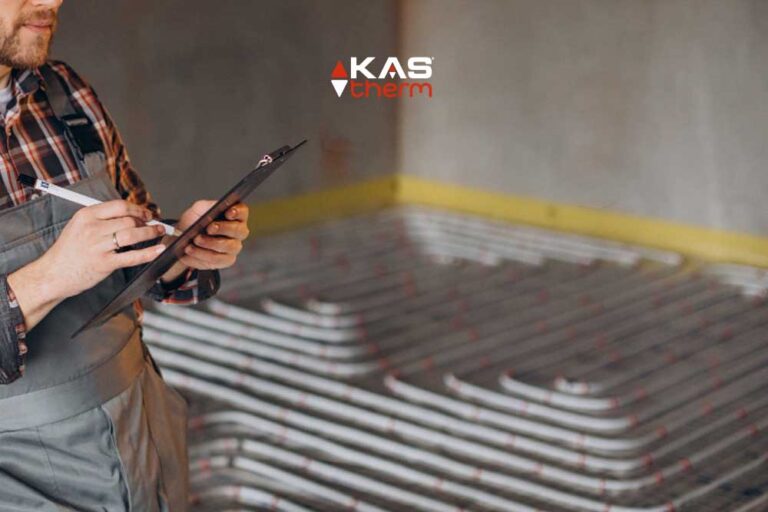
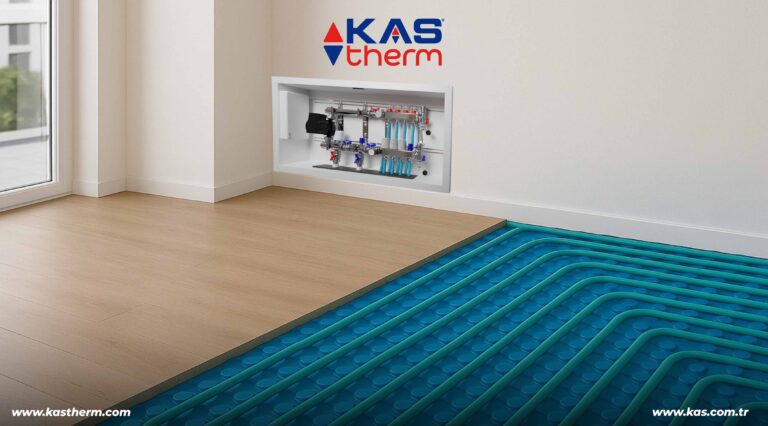
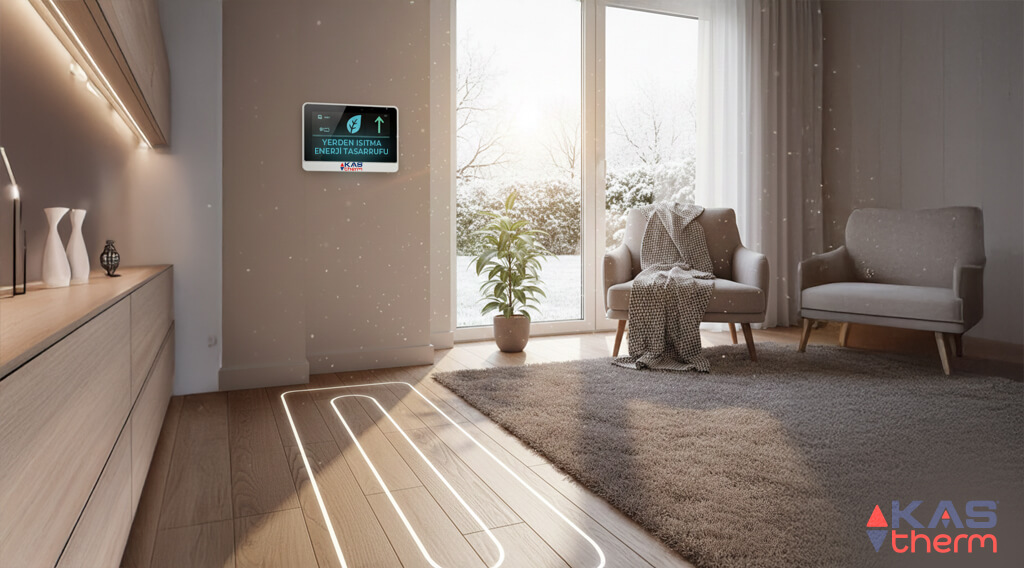
Underfloor heating works on the principle of heat rising naturally from the floor upwards. Heating pipes are installed beneath the flooring, and warm water circulating through these pipes heats the floor, creating a balanced and comfortable temperature throughout the space.
The main reasons why this method provides energy savings include:
- It operates at low temperatures (typically 30–45°C).
- Heat is distributed evenly across the entire floor surface.
- There is no localized overheating or heat loss as seen in radiator systems.
- Because heat is distributed uniformly, the heat source consumes less energy and reaches the desired temperature more quickly.
How Much Energy Can Underfloor Heating Save?
According to standard building simulations, underfloor heating systems provide:
- Up to 30% energy savings compared to classic radiator systems.
- Lower energy consumption due to low operating temperatures.
- Even higher savings when used with innovative systems like heat pumps.
The exact rate of energy savings depends on:
- Quality of insulation
- Type and density of heating pipes
- Floor covering
- Type of heat source (boiler, heat pump, etc.)
- Use of smart room thermostats
- Installation quality and hydraulic balancing
- Use of flow-controlled manifolds with built-in flow meters
8 Main Reasons Underfloor Heating Saves Energy
1. Low Water Temperature Operation
Radiators require high water temperatures due to their limited surface area.
Underfloor heating covers a wide area, enabling efficient heating even at 30–45°C.
2. Homogeneous Heat Distribution
Radiators accumulate heat around the source, causing the system to work harder.
Underfloor heating distributes heat equally from every point of the floor.
3. Reduced Heat Loss
Lower temperature differences result in minimized heat loss.
4. Full Compatibility with Heat Pumps
Heat pumps operate most efficiently at low temperatures.
Underfloor heating significantly improves the heat pump’s COP (Coefficient of Performance).
5. Easier Thermal Comfort
A warm floor provides comfort even at slightly lower room temperatures.
This allows the system to operate 1–2°C lower, reducing energy consumption.
6. Dynamic Control with Room Thermostats
Each room can be controlled independently.
Unused areas can be set to minimum heating levels.
7. Low Air Circulation
Less air movement results in less heat loss—improving overall energy efficiency.
8. Large Heating Surface Area
The entire floor acts as a large radiator, heating larger areas with lower energy use.
How Do KAS Therm Underfloor Heating Systems Increase Energy Savings?
KAS Therm offers high-performance pipes, distribution components, and installation solutions designed for maximum efficiency in underfloor heating applications.
1. KAS Therm PE-RT and PEX Pipes
KAS Therm pipes feature:
- High thermal conductivity
- Strong durability
- Low expansion rates
These characteristics ensure:
- Even heat distribution
- Reduced heat loss
- High efficiency even at low temperatures
2. Oxygen Barrier Technology
KAS Therm’s oxygen-barrier pipes prevent corrosion in metallic components.
This keeps heat transfer stable for many years and reduces energy losses.
3. Full Compatibility with Heat Pumps
KAS Therm systems are engineered for low-temperature heat sources, maximizing heat pump performance.
4. Professional Balancing with Flow-Meter Manifolds
KAS Therm manifolds and installation accessories ensure optimal water flow and hydraulic balance.
A properly balanced underfloor heating system uses no more energy than necessary.
5. Long-Lasting System Structure
Energy efficiency is not limited to the initial years.
KAS Therm pipes and components require minimal maintenance, ensuring long-term performance.
In Which Conditions Is Higher Energy Saving Achieved?
Maximum savings occur when:
- Full automation is used (manifold with flow meters, actuators, room thermostats)
- The system operates with a heat pump
- Proper sub-floor insulation is provided
- High-conductivity floor coverings like ceramic or stone are preferred
- Underfloor-heating-compatible laminate or parquet is used
- Zone-control (individual area control) is implemented
- High-quality PE-RT or PEX pipes are selected
These conditions are standard in KAS Therm underfloor heating projects, designed with professional engineering support.
Energy-Efficient, Comfortable, and Economical Heating
KAS Therm underfloor heating solutions are designed for users who want:
- Lower energy costs
- A durable, long-lasting system
- Efficient and comfortable heat distribution
With professional installation, high-quality pipe systems, and correct engineering, up to 30% energy savings are achievable.
Underfloor heating is a modern heating method that delivers energy efficiency thanks to its low-temperature operation and homogeneous heat distribution.
When combined with the right materials and design, both comfort and efficiency increase significantly.
KAS Therm underfloor heating systems deliver maximum comfort and energy savings with durable pipes, high efficiency, and advanced engineering solutions.
Contact the KAS Therm expert team.
Let’s design the most efficient underfloor heating system for your project together.